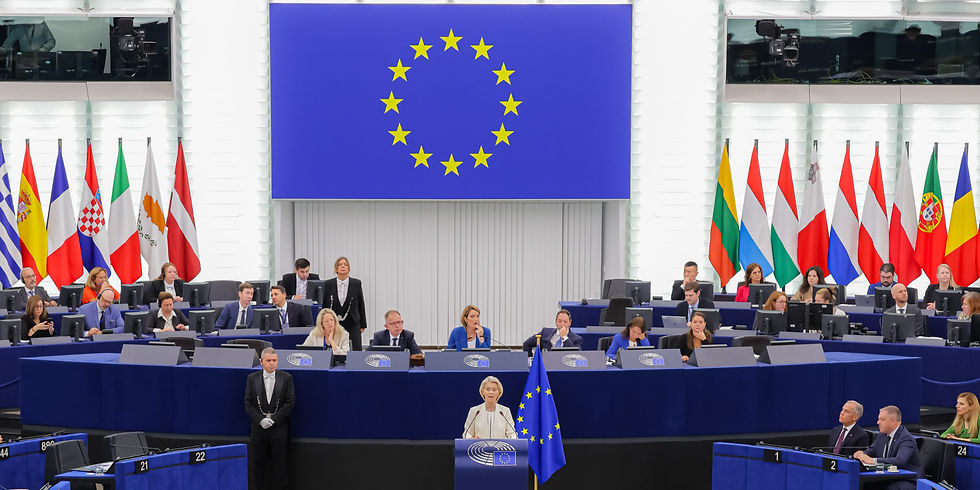
'European Union- Standing Up for One Another', European Commission Work Programme 2027

Updated: 4 hours ago

On 4 November, the European Commission published its Work Programme 2027, setting out the most important new policy and legislative initiatives it intends to take forward in the year ahead. The programme is entitled ‘European Union- Standing Up for One Another’, outlines the Commission’s priorities and planned actions for 2027.
Key takeaway:
On sustainability, prosperity, and competitiveness
Among the new initiatives, the Commission plans to present a proposal on permitting acceleration (legislative or non-legislative, Q3 2027) and an initiative on Single Market barriers prevention (legislative or non-legislative, Q3 2027). In the financial sector, a Bank competitiveness and simplification package is planned for Q1 2027 (legislative, including an impact assessment, Article 114 TFEU). The Commission also intends to address ReFuelEU Aviation in Q2 2027 (legislative, including an impact assessment, Article 100(2) TFEU).
Another notable initiative is the proposed European Corporation on Critical Raw Materials (legislative or non-legislative), reflecting the growing strategic importance of securing access to the raw materials needed for Europe’s industrial and technological ambitions.
Supporting people, strengthening societies and social model
Housing, skills and care feature prominently in the social dimension of the 2027 programme. Building on the work already undertaken on the Affordable Housing Plan, the Commission plans a new Housing Simplification Package (legislative, including an impact assessment, Q2 2027).
To strengthen cooperation between universities and boost skills and innovation, the Commission proposes European Universities Alliances 2.0.
A European Care Deal is also planned for Q2 2027 (non-legislative), with a focus on promoting affordable and accessible care while improving career prospects and working conditions in the care sector.
Sustaining our quality of life: food security, water and nature
Climate resilience and natural resources are another important part of the programme. The Commission plans to introduce a European heatwave plan (non-legislative, Q2 2027), a European water initiative (legislative or non-legislative, Q2 2027), and a Review of nature protection directives, including Birds, Habitats, Natura 2000 (legislative/non-legislative, Q3 2027)
The Commission also intends to conduct a Review of the CO₂ emission standards for heavy-duty vehicles (legislative, including an impact assessment, Article 192(1) TFEU, Q3 2027).
Defence and security
Defence and security are set to remain major priorities in 2027. On internal security, the Commission plans an initiative on international data exchange for police cooperation (Prüm International) (legislative, including an impact assessment, Articles 87(2)(a) and 88(2) TFEU, Q2 2027).The Commission intends to establish a new European instrument for Strategic Enablers, strengthening Europe’s ability to address critical defence capabilities; it envisages a European Security Emergency Protocol, aimed at helping Member States cooperate more closely and develop a more coordinated European response to energy-security challenges.
At the same time, further work is envisaged on operationalising the EU’s mutual defence clause under Article 42(7) TEU. The programme also raises the prospect of a European Security Council.
The programme also confirms the EU’s continued support for Ukraine, including work on an EU–Ukraine Defence Industrial Pact.
Protecting democracy
The Commission aims to strengthen the EU’s capacity to address foreign interference, democratic backsliding and threats against political candidates and elected representatives. Among the planned measures is a Commission Recommendation on safety in politics (non-legislative, Q1 2027). The Commission also plans a Review of the political advertising Regulation (legislative or non-legislative).
Final thoughts
The Work Programme 2027 presents 23 new initiatives, alongside 18 proposals for withdrawal; 24 pending priority proposals and 14 proposals to repeal. As the European Commission concludes, 'Europe will only be stronger if we work together at different levels and across borders. The time to deliver on our independence is now'. Simplification, ramping up competitiveness, stronger cooperation in security and defence, and protecting democracy will be dominant in 2027. Overall, the Work Programme reflects the need for simplification of existing EU policies and legislation, which will be better equipped to respond to Europe’s economic, security and societal challenges.