State of the Union 2026: Key takeaways
Updated: 1 hour ago
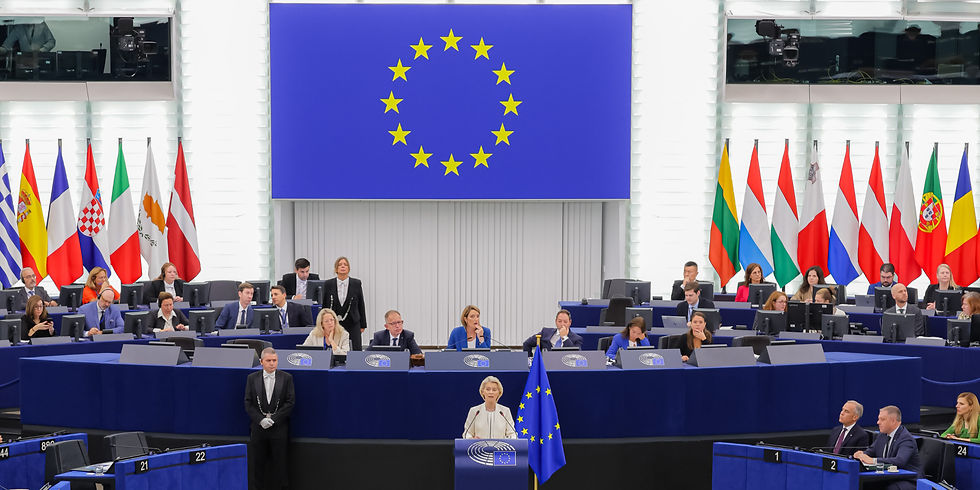
European Commission President Ursula von der Leyen used her 2026 State of the Union address to set out an ambitious agenda for a Europe that is more competitive, more resilient and better equipped to act in an increasingly challenging geopolitical environment.
A central message of the speech was clear: Europe needs to move faster.
Competitiveness: Europe needs to move faster
Building on the work of Mario Draghi and Enrico Letta, von der Leyen highlighted the progress made on Europe's competitiveness agenda while stressing that significant barriers remain.
One of the most important challenges is the continued fragmentation of Europe's capital markets. If Europe wants innovative companies to grow and compete globally, it needs to mobilise more private investment and make it easier for capital to flow across borders.
But simplification cannot come from Brussels alone. Von der Leyen stressed the responsibility of Member States, calling on national governments to step up their efforts if Europe is serious about reducing administrative burdens and making its economy more competitive. The Commission also aims to complete the One Europe, One Market Roadmap by the end of 2027.
The Commission also intends to pursue further simplification in the financial sector through a New Banking Package, with the objective of creating a European banking system that is not only stable, but also capable of supporting investment and growth.
Energy and reducing Europe's strategic dependencies
Europe has made considerable progress in expanding renewable energy. Around 80 GW of new renewable capacity was installed last year. However, von der Leyen pointed to a major bottleneck: significantly more capacity is waiting to be connected to Europe's electricity grids.
Her message was that producing renewable electricity is not enough. Europe also needs the grids, infrastructure and investment required to bring that electricity to businesses and consumers.
The push for greater European independence extends beyond energy. Critical raw materials are essential for technologies ranging from batteries and renewable energy infrastructure to semiconductors, defence systems and digital technologies. Europe remains dependent on external suppliers for many of these resources. Von der Leyen therefore announced plans to strengthen European Corporation on Critical Raw Materials, with the objective of securing supply chains and reducing potentially dangerous dependencies.
Trade and relations with China
Von der Leyen pointed to the EU's substantial trade deficit with China and argued that the current relationship needs to become more balanced. The objective, therefore, is not disengagement but a more balanced relationship. The EU intends to use the instruments available to it to defend European economic interests while seeking workable solutions with Beijing.
Trade more broadly remains an important part of Europe's economic strategy. Von der Leyen highlighted the EU's recent trade agreements and partnerships, including those involving Mercosur, India and Australia, as examples of Europe's efforts to diversify economic relationships and build stronger international partnerships. She also announced plans for a Regional Connectivity Summit with Bulgaria aimed at strengthening partnerships and strategic cooperation in the region.
Canada as the EU’s first associate member?
Canada received particular attention in the speech as one of Europe's closest international partners. Von der Leyen highlighted the shared commitment of the EU and Canada to democracy and common values and called for an even stronger relationship between the two sides. Among the most notable proposals was the idea of giving Canada a new form of association with the European Union, signalling an ambition to deepen cooperation with like-minded democratic partners.
European security
Against the backdrop of Russia's war against Ukraine and wider security challenges facing the continent, von der Leyen stressed that Europe must be able to respond more effectively when its security is threatened. She proposed a new European Security Strategy and raised the idea of developing a European mechanism inspired by NATO's Article 4, which allows allies to consult when the security of a member is threatened.
Climate resilience and Artificial intelligence
Climate change is increasingly being experienced not as a future risk but as a present reality.
Following another summer marked by extreme heat and fires, von der Leyen announced further measures aimed at strengthening Europe's resilience to climate-related risks. The Commission's upcoming agenda is expected to include measures addressing the climate resilience package, heatwaves package and water management.
Von der Leyen also struck an optimistic note on artificial intelligence. AI, she argued, has enormous potential to improve people's lives when developed and deployed responsibly.
But technological progress must remain consistent with European principles. For von der Leyen, Europe's task is therefore not simply to adopt artificial intelligence but to ensure that it is developed and used in a distinctly European way- combining innovation with safety, fundamental rights and human-centred values.
Protecting children online and Enlargement
Children's use of social media emerged as another significant digital-policy priority.
The Commission is preparing an EU Kids Act, with proposals aimed at creating stronger safeguards for minors online, including age-related rules governing children's access to social-media accounts.
On EU enlargement, von der Leyen indicated that candidate countries will receive Clearer Roadmaps setting out where progress has been achieved and where further work remains necessary.
The Commission is seeking a more competitive European economy, deeper capital markets, faster electrification, more secure supply chains and stronger partnerships with democratic allies. At the same time, it wants Europe to become more resilient to security threats, climate change and the risks accompanying rapid technological transformation. Achieving those objectives will depend not only on EU institutions. Von der Leyen's message to Member States is clear: if Europe wants to become faster, simpler and more capable of acting, national governments will also have to play their part. The coming year will therefore be a test of whether Europe can translate its ambitions into implementation.


